
The Poisoner’s Handbook & the Victorian Era’s Toxic Love Stories

saintgeorgesflushing.org – In the shadowy corners of Victorian society, where the gas lamps flickered and the cobblestone streets whispered secrets, there existed a world where love and death intertwined in the most sinister of dances. This was the era of the “Poisoner’s Handbook,” a chilling account of a time when passion and poison went hand in hand, and the science of murder was as intricate as the lace on a lady’s glove.

The Victorian age, with its strict moral codes and rigid social structures, was a period of stark contrasts. On one hand, it was an era of unprecedented scientific advancement and industrial growth. On the other, it was a time when the darker aspects of human nature played out in the most macabre of ways. Nowhere was this more evident than in the crimes of passion that shook the very foundations of Victorian society.

“The Poisoner’s Handbook” delves into the stories of those who turned to toxicology not for healing, but for harm. It was an age when arsenic could be found in the flypapers hanging on the walls, strychnine was used to kill rodents, and digitalis, a heart stimulant, was just as likely to stop a heart as to start it. These poisons were the weapons of choice for those who sought to rid themselves of unwanted spouses, to inherit fortunes, or to escape the drudgery of their lives.

One of the most infamous cases of the time was that of Mary Ann Cotton, known as the “Black Widow.” She was a serial killer who used arsenic to dispose of her family members and collect insurance money. Her story is a grim reminder of the ease with which poison could be obtained and the devastating effects it could have on unsuspecting victims.

But the rise of these crimes also sparked a revolution in forensic science. The Victorian era saw the birth of toxicology as a discipline, with pioneers like Dr. Robert Christison and Dr. Alfred Swaine Taylor leading the charge. These men developed methods for detecting poisons in the body, laying the groundwork for modern forensic toxicology.

The science of murder became as much a part of the Victorian landscape as the steam engines that powered the Industrial Revolution. Autopsies became more sophisticated, and the microscope became a detective’s best friend. The battle between poisoner and scientist was a deadly game of cat and mouse, with the fate of the accused hanging in the balance.

“The Poisoner’s Handbook” is not just a chronicle of crime and punishment; it is a testament to the human spirit’s capacity for both evil and ingenuity. It reveals a society where the veneer of respectability could not conceal the rot within, and where the quest for knowledge was as relentless as the pursuit of justice.

As we look back on the Victorian era, we are reminded that the line between love and hate, life and death, can be as thin as the edge of a razor. “The Poisoner’s Handbook” invites us to peer into the abyss and confront the darkness that lies within us all. It is a cautionary tale for the ages, a reminder that the heart can be as poisonous as any vial of arsenic, and that the only antidote may be the light of reason and the pursuit of truth.

Unveiling the Secrets of Suburban Homicide: Killer Next Door

saintgeorgesflushing.org – In the tranquil and manicured lawns of suburbia, where the American Dream is often painted in the colors of white picket fences and family barbecues, lies a darker reality that seldom makes it to the postcard. This is the world of suburban homicide, where the killer next door shatters the illusion of safety and community, leaving neighbors in disbelief and the wider world asking how such horrors could be hidden in plain sight.

Suburban homicide, while statistically less common than urban violence, carries a unique psychological impact due to the perceived safety and homogeneity of suburban life. These crimes often involve individuals who are, by all outward appearances, upstanding members of their community. They are the neighbors who wave hello, the parents who coach Little League, and the volunteers at local charity events. This duality makes suburban homicides particularly chilling, as they challenge our ability to discern the true nature of those around us.

The Psychology of the Suburban Killer

Understanding the psychology of the suburban killer is crucial to unraveling the secrets of these crimes. Unlike their urban counterparts, who may be driven by factors such as gang violence, poverty, or drug trade, suburban killers often act out of personal motivations. These can range from domestic disputes that escalate to violence, to more complex psychological issues such as narcissism, control issues, or deep-seated resentment.

The suburban environment itself plays a role. The pressure to maintain a certain image, the isolation that can come from living in sprawling communities, and the monotony of suburban life can exacerbate underlying psychological issues. For some, the facade of normalcy becomes a mask behind which darker impulses can fester.

The Impact on the Community

The aftermath of a suburban homicide is devastating. The sense of betrayal and loss is compounded by the realization that the danger was not just outside, but within the community. Neighbors are left questioning their judgment, their safety, and the very fabric of their community. The media attention that often follows can further isolate the community, as the world’s gaze turns to the idyllic setting that harbored such horror.

Unveiling the Secrets

Unveiling the secrets of suburban homicide requires a multifaceted approach. It involves understanding the psychological profiles of those capable of such acts, recognizing the warning signs that may be hidden in plain sight, and fostering a community environment that encourages openness and support rather than the maintenance of facades.

Law enforcement and mental health professionals play crucial roles in this process. Training for law enforcement should include the nuances of suburban crime, including the importance of community engagement and the subtleties of suburban life. Mental health professionals can work to destigmatize mental health issues and provide support systems that might prevent the escalation of issues into violence.

Conclusion

The killer next door is a stark reminder that evil can hide in the most unexpected places. Unveiling the secrets of suburban homicide is not just about solving crimes; it’s about understanding the complexities of human behavior and the environments in which we live. It’s about building communities that are resilient, supportive, and aware. Only then can we hope to prevent the tragedies that lurk behind the white picket fences of suburbia.

The great Journey of Monarchs: Secrets of Butterfly Migration

The migration of monarch butterflies is one of nature’s most awe-inspiring phenomena, a journey that spans thousands of miles and multiple generations. Each year, these delicate creatures embark on a perilous odyssey, driven by an innate navigational system that guides them from the United States and Canada to the oyamel fir forests of central Mexico and the coastal groves of California. This article delves into the remarkable journey of monarch butterflies, exploring the science behind their migration, the challenges they face, and the conservation efforts aimed at protecting this iconic species.

The Migratory Path:
The monarch migration is a cycle that begins in late summer and early fall, as the butterflies born in the northern regions of the United States and Canada start their southward journey. These monarchs are not the same individuals that will complete the trip; instead, they are part of a relay that spans generations. It takes up to three generations of monarchs to complete the full migration, with each generation living only a few weeks before laying eggs for the next.

The monarchs use a combination of the sun’s position, the Earth’s magnetic field, and landmarks to navigate their way south. They fly during the day and roost at night, covering distances of up to 100 miles per day. The journey is fraught with dangers, including predators, storms, and exhaustion, yet the monarchs are remarkably resilient.

The Overwintering Sites:
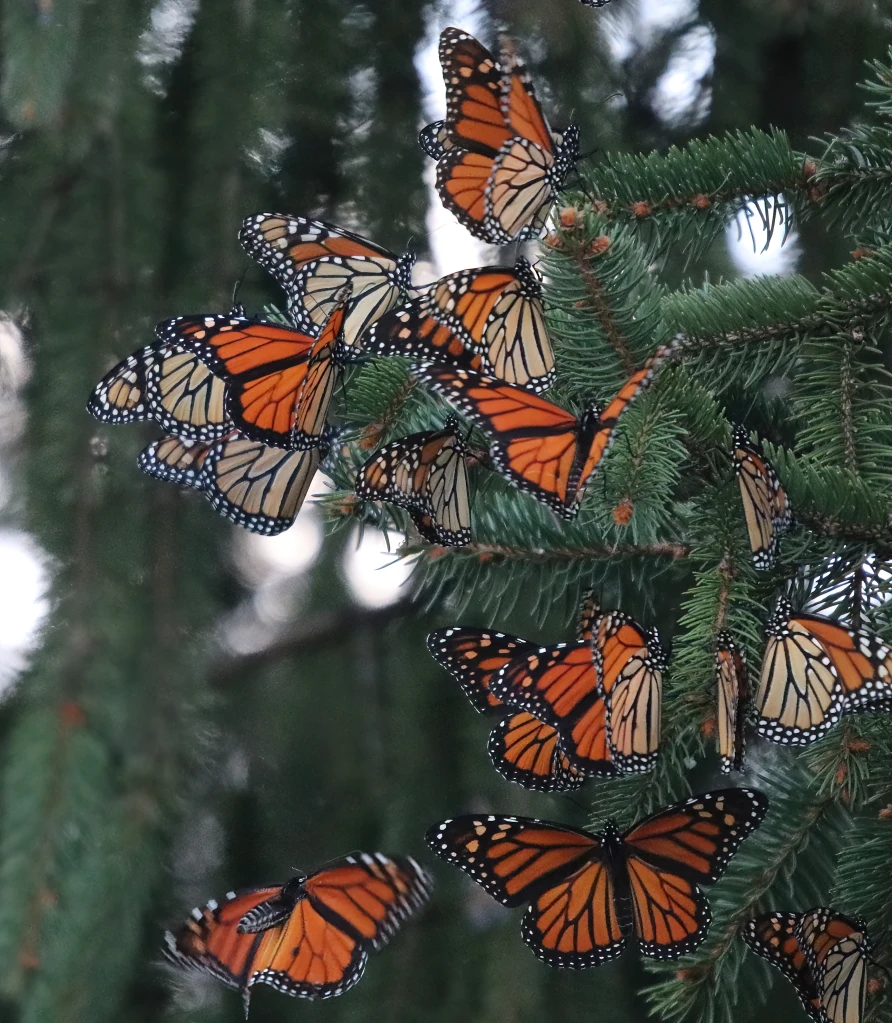
After a grueling journey, the monarchs arrive at their overwintering sites. In Mexico, they cluster in the high-altitude oyamel fir forests, where millions of butterflies can cover the trees, creating a breathtaking spectacle. In California, they gather in groves along the coast, where they form dense clusters on tree branches. These sites are critical for the monarchs’ survival, offering protection from the elements and predators.

The Return Migration:
In the spring, the monarchs begin their northward journey. The butterflies that leave the overwintering sites are not the same ones that arrived the previous fall; they are the offspring of those original migrants. These new generations will lay eggs along the way, with the final generation reaching the northern breeding grounds. The cycle then repeats, with the next generation beginning the southward migration in the fall.

Conservation Challenges:
The monarch butterfly’s migration is under threat from habitat loss, climate change, and the use of pesticides. The destruction of milkweed, the plant on which monarchs lay their eggs and on which their larvae feed, is a significant concern. Additionally, the oyamel fir forests in Mexico are under pressure from logging and development. Conservation efforts are underway to protect the monarch’s habitat, including the establishment of protected areas and the promotion of milkweed planting.

Conclusion:
The migration of monarch butterflies is a testament to the wonders of nature and the resilience of life. It is a journey that has captivated scientists and nature enthusiasts alike, inspiring awe and a sense of stewardship for the natural world. As we continue to learn from and protect the monarchs, we are reminded of the interconnectedness of all life on Earth and the importance of preserving the habitats that support such remarkable phenomena. The monarch’s migration is not just a journey across continents; it is a journey through time, a living legacy that connects generations of butterflies and people alike.